How artificial grass is installed, step by step.
A good artificial grass install is mostly groundwork. Here’s each step, what a careful installer does at each one, and the red flags behind dips, puddles and lifting edges.
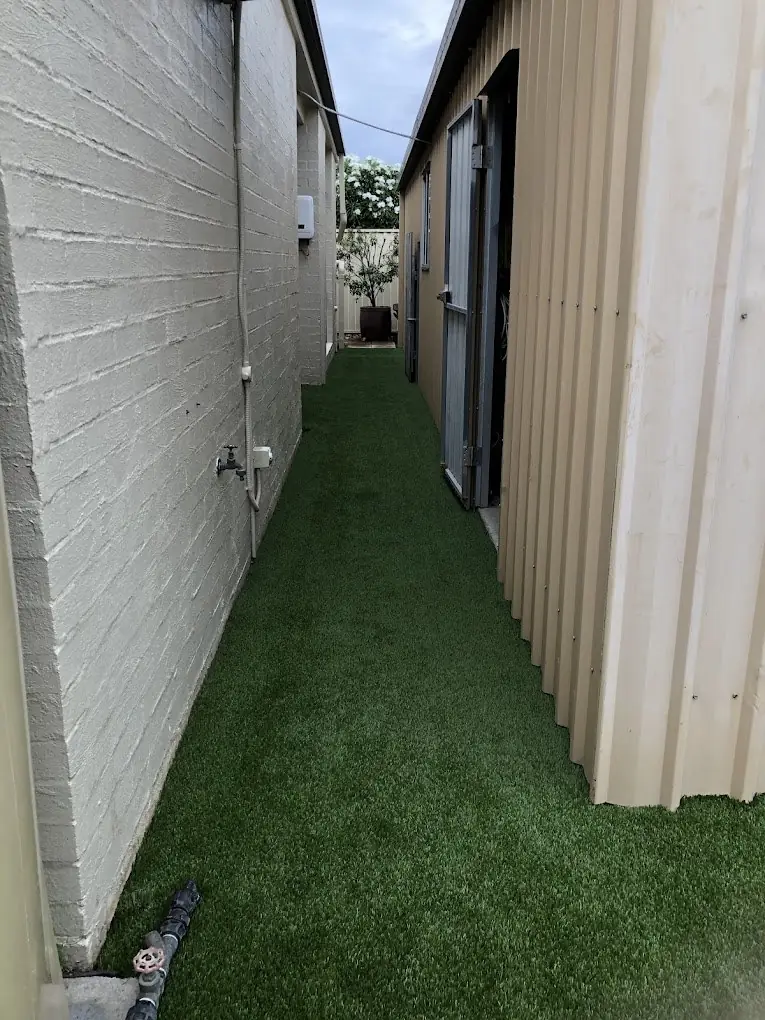
The short answer: a proper artificial grass install starts by digging out the old surface, then building a crushed-rock base that’s compacted hard and levelled with a slight fall so water drains. The edges are set, then the turf is rolled out, cut, joined and pinned, and infill is brushed in. Most problems people see later, like dips, puddles, lifting edges and visible seams, come from shortcuts in the groundwork rather than from the turf itself.
Here’s each step in order, and what a careful installer does at each one.
Step 1: Measure, plan and quote
A careful installer looks at more than square metres. They check access for machines and wheelbarrows, what’s there now, where water sits after rain, slopes, trees and roots, how you’ll use the area, and where the joins will fall.
The written quote should name the turf product and describe the base: what material, how deep, and how it’s compacted. If it doesn’t, ask.
Step 2: Dig out the old surface
Lawn, weeds, roots and soft topsoil come out, deep enough to fit the base the site needs. Old grass left underneath breaks down and settles, which is how turf ends up lumpy.
Step 3: Build the base
This is the answer to the common question “what goes under artificial grass?” The base is usually crushed rock, spread and compacted, and some installers finish it with a thin layer of finer material for a smooth surface. Soft or wet ground may need a deeper base. Sand or soil on its own moves and settles too easily to make a good base.
Step 4: Compact and level
The base is compacted (packed down hard, usually with a plate compactor) until it doesn’t move underfoot. It’s levelled with a gentle fall so water flows across and away. This is the moment to fix low spots: once the turf goes down, a low spot becomes a puddle.
Step 5: Plan the drainage
Most artificial grass drains through holes or a permeable backing, but the water still needs somewhere to go. A good installer checks the fall, keeps water moving away from the house and fences, and deals with any existing drainage problem before laying.
Step 6: Set the edges
Turf needs a firm edge to fix to. That can be existing concrete or paving, or new edging such as timber. Without a firm edge, the turf drifts, lifts or lets weeds in from the side.
Some installers also lay a weed barrier, a permeable fabric, over the base. Ask whether your quote includes one and why.
Step 7: Lay, cut and join
Turf comes in rolls of set widths, so most lawns need joins. Every piece should run with the fibres leaning the same way, or the colour can look patchy. Joins are usually glued onto a joining tape underneath so the backing sits tight with no gap. Edges are trimmed neatly against walls, paths and garden beds.
Step 8: Pin and secure
Edges and joins are fixed down with pins into the base, or glued where the turf sits on concrete. Loose edges are the first thing to lift and the first thing a dog will dig at.
Step 9: Brush in the infill
Depending on the product, infill (a fine material such as sand) is spread and brushed down into the fibres. It helps weigh the turf down and keep the blades standing up. Infill types vary, and the research on sports fields covers sand, rubber and cork. Follow the turf maker’s guide for your product.
Step 10: Clean up and hand over
Waste is removed, the site is cleaned up, and you’re shown how to look after the turf: brushing, leaves, pets, and what to keep off it, such as cigarettes and hot coals.
How long does it take?
That depends on the size of the area, the access and how much digging there is. Your quote should tell you how long the job will take, so you can plan around it.
Red flags when choosing an installer
Common DIY mistakes
Getting it done properly
We install artificial grass across Melbourne in this order, with the owner on site from the first dig to handover. If you’re comparing quotes, check that each one lists removal, the base material and depth, edging, the turf product and the warranty, so you’re comparing artificial grass costs like for like. Laying over an existing slab instead? Read artificial grass on concrete.
From EKO Gardening Solutions. Sources checked on 8 October 2026.
Want a price for your yard?
A few useful answers.
Have a question about your own space?
Tell us what you have in mind.
What goes under artificial grass?
A compacted crushed-rock base, levelled with a slight fall so water drains, and sometimes a weed barrier. Soil or sand on its own moves and settles too easily to make a good base.
Can you lay artificial grass on dirt?
Not directly if you want it to last. Soil and old grass settle and hold water, so the surface is dug out and replaced with a compacted base first.
How are artificial grass joins done?
Usually by gluing the two edges onto a joining tape underneath, with the fibres of both pieces leaning the same way so the seam is hard to spot.
Do you need a weed mat under artificial grass?
Not always. A well-compacted base, tight joins and secure edges leave weeds little room, but some installers add a permeable weed barrier as well. Ask what your quote includes and why.
Sources
Keep reading.
Let’s make more of your garden.
Tell us about your space.
We’ll help you work out the next step.