Synthetic putting greens · Melbourne
A putting green in your own backyard.
- 5.0 on Google · 8 reviews
- Insured · ABN registered
- We reply within 12 business hours
Thinking about a synthetic putting green? Here’s how a backyard green is built, how it differs from a normal artificial lawn, and what to send us for a quote.
- Your weekends, without mowing
- More room to enjoy your yard
- No surprise fees
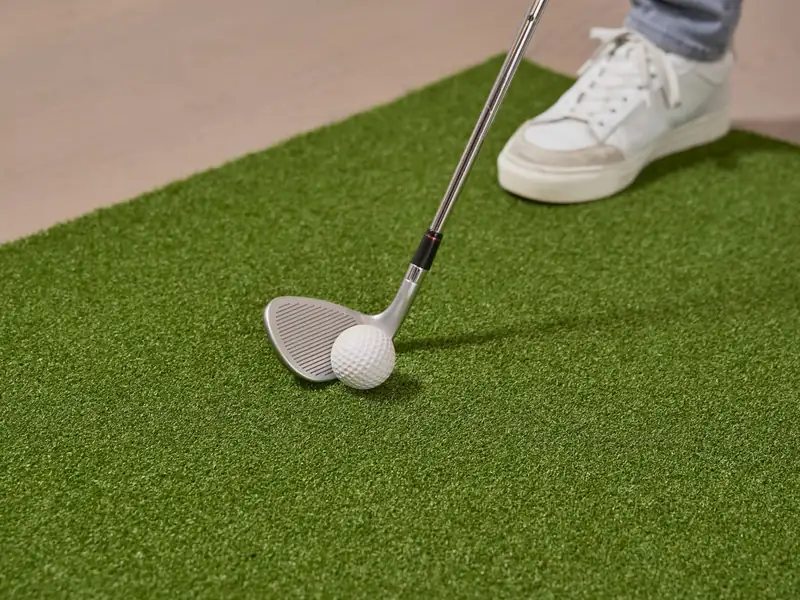
For a golfer, a backyard putting green is somewhere to practise any day of the week. It’s also one of the less forgiving turf jobs: a lawn can hide a small dip, but a golf ball will find it.
Ready for a free quote?
Tell us your suburb, roughly how big the area is and send a few photos.
How a putting green differs from an artificial lawn
What goes into building one
- Design. We work out the size, shape, number of holes and any slopes with you, and where the green sits in relation to the house, the sun and the rest of the yard.
- Excavation. The old surface comes out and is taken away, like any of our turf jobs.
- Base. A crushed-rock base is laid and compacted hard, then finished smooth and shaped to the slopes you want.
- Edging. A firm edge holds the green’s shape and keeps the base from spreading.
- Turf and holes. The putting turf is laid and joined, the cups are set, and the turf is cut neatly around them.
- Infill and finish. If the product calls for infill, it’s brushed in to the turf maker’s guide, then we clean up.
Where a green works best
Planning your green
A few decisions shape the design and the price, so it helps to think about them before we talk:
Looking after it
Keep leaves and debris off, brush it as the turf maker recommends, and follow their guide for any infill top-ups. Like any synthetic turf, keep cigarettes, coals and hot barbecue gear away from it.
Getting a quote
Send us photos of the spot, rough measurements in metres, how many holes you’d like, and whether you want slopes to practise on. Price depends mostly on the size, the base work and the putting turf you choose. Your written quote spells out the scope, so you can compare artificial grass costs like for like, and our artificial grass installation page shows how we build the base underneath.
Want a price for your yard?
A clear path to getting it done.
- 01
Show us your space
Share your suburb, roughly how big the area is and a few photos.
- 02
Free measure & quote
We look at the ground, access and levels, then give you a written quote.
- 03
Agree the work
Know the work and price before you commit. Changes are agreed with you first.
- 04
Enjoy the result
We complete the work, tidy up and explain any ongoing care.
A few useful answers.
Have a question about your own space?
Tell us what you have in mind.
How big does a backyard putting green need to be?
There’s no fixed size. It depends on your yard, how many holes you want and whether you want slopes to practise on. Send us your measurements and photos and we’ll talk through what fits.
Can a putting green go next to an artificial lawn?
Yes. A green can sit within or beside an artificial lawn, with longer turf around it. The two products are different, so the join between them needs planning.
Does a putting green need more care than lawn turf?
It needs a little more attention to keep the ball rolling true: keep leaves and debris off, brush it as the turf maker recommends, and follow their guide for any infill.
Keep reading.
Ready to make a start?
Tell us about your space.
We’ll help you work out the next step.